

Call us now
08045813532
Call us now
08045813532

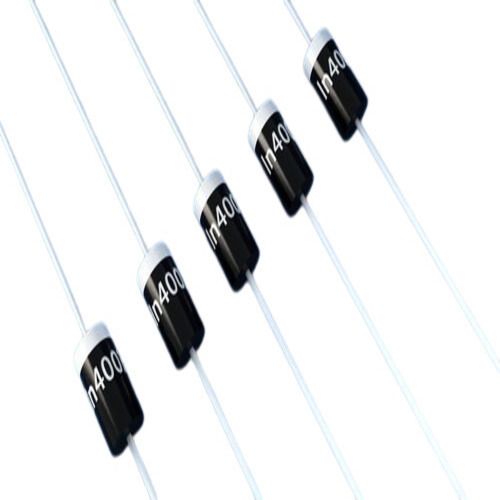
A diode is a two-terminal electronic component that allows electric current to flow in only one direction. It acts as a one-way switch, conducting current when voltage is applied in the "forward" direction (from anode to cathode) and blocking it in the "reverse" direction. This property is fundamental to many applications, such as rectifying alternating current (AC) into direct current (DC) and protecting circuits.
How it works
Anode and cathode: A diode has two terminals: an anode (positive) and a cathode (negative).
Forward bias: When the anode is more positive than the cathode, the diode is "forward-biased" and conducts current.
Reverse bias: When the anode is more negative than the cathode, the diode is "reverse-biased" and blocks current.
P-N junction: Diodes typically achieve this one-way conduction through a p-n junction, a boundary between p-type and n-type semiconductor materials.

Price:


 Send Inquiry



 Send Inquiry
 Send Inquiry
 Send SMS
 Call Me Free